
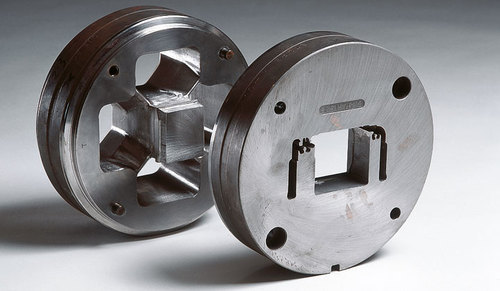
In 2026, the world of extrusion dies has moved far beyond simple “shaping.” The focus has shifted toward Intelligence, Sustainability, and Extreme Precision as manufacturers look to cut costs in a high-tariff, high-energy-cost environment.
Here are the latest trends reshaping extrusion die technology:
1. “Smart” Dies and Digital Twins
The most significant leap is the integration of Industry 4.0 directly into the die assembly.
Embedded Sensors: Modern dies are increasingly equipped with real-time sensors that track internal temperature, pressure, and flow rates. This data is fed into “Virtual Assistants” that can automatically adjust the press speed or cooling to prevent defects.
Digital Twins: Before a single piece of steel is cut, manufacturers use advanced simulation software (like Qform) to create a digital replica of the die. This can reduce trial-and-error iterations by up to 30%, saving thousands in energy and scrap costs.
2. Additive Manufacturing (3D Printing)
3D printing is no longer just for prototypes; it is now being used to create functional die components.
Conformal Cooling: 3D printing allows for internal cooling channels that follow the exact geometry of the die profile. This leads to more uniform cooling, faster cycle times, and reduced warping in complex profiles.
Hybrid Dies: Manufacturers are combining traditional CNC machining with 3D-printed inserts to create dies with “impossible” internal geometries or integrated lattice structures for weight reduction.
3. Advanced Nano-Coatings
To combat the rising cost of raw materials, dies must last longer. New coating technologies are extending tool life significantly:
Nano-Structured Coatings: Ultra-thin layers of specialized ceramics or diamond-like carbons (DLC) are being used to provide superior abrasion resistance.
Self-Lubricating Surfaces: These coatings reduce the “friction heat” generated during extrusion, allowing for higher production speeds without damaging the surface finish of the product.
4. Near-Net-Shape and Miniaturization
As industries like medical devices and aerospace demand smaller, lighter parts, die technology has adapted:
Micro-Extrusion: Precision dies can now produce ultra-thin-walled tubing (often used in surgical tools) with tolerances measured in microns.
Near-Net-Shape: The goal in 2026 is to extrude a shape so close to its final form that it requires zero secondary machining, drastically reducing material waste (scrap).
5. Sustainability and Circularity
With “Net-Zero” targets becoming mandatory for many manufacturers:
Recycled Billet Optimization: Dies are being redesigned to handle high-recycled-content aluminum or “green” plastics, which often have different flow characteristics than virgin materials.
Energy-Efficient Profiles: Die designs are being optimized to lower the “breakthrough pressure” required to start the extrusion, which directly reduces the electricity consumption of the press.
Comparison of 2024 vs. 2026 Die Tech
| Feature | 2024 Standard | 2026 Trend |
| Maintenance | Scheduled (Reactive) | Predictive (AI-driven) |
| Design | Trial-and-error testing | Digital Twin simulation |
| Cooling | External air/water | Internal Conformal Cooling |
| Lead Times | 4–6 weeks | Rapid prototyping (<1 week) |